DOUBLE TRACKER
The Original
Vetta Double Tracker Examined
by Nathan Shane
I have
been surprised at how disappointed some are about the Vetta's Double
Tracker. Some claim that they cannot hear the effect, or that the
effect does not work right. Whether you're a novice or a pro, it
has been my musical experience, that when someone claims they cannot
hear a particular effect, it is simply because their musical ear
has not yet developed the ability to distinguish the effect. And
how could anyone say the DT doesn't work "right" without actually
knowing how Line 6 engineers define "right" according to
the intended design. Therefore, it would be unfair to harshly criticize
Line 6 or the Vetta for an effect that one doesn't fully comprehend.
Now I'll
be the first to admit, having already understood the recording
production technique of double tracking, what I had envisioned
in my head was going to be this miraculous, 100% accurate simulation,
just like it sounds on a CD effect...but it wasn't. But then again,
I realized my expectation was un-realistic, because no one else
has attempted to simulate this effect to this degree in an amp
before. So technically, there was really nothing to compare it
to other than some "ideal" I had floating
in my head about how I thought it was supposed to sound, especially
in comparison to real double tracked guitars.
I suppose
I was really expecting the DT to make a SUPER HUGE difference in
the sound, or make one of the modeled amps sound "exactly" like
a separate guitar player was playing (doubling) a track alongside
my playing. After experimenting with the DT, and thinking realistically
about it...double tracking is a big call to try and reproduce with
DSP (digital signal processing) technology. The sheer fact that
the Vetta comes as close as it does to simulating double tracking
is extremely impressive. And now that I've worked more with it,
I'm so glad the effect was included. The Double Tracker is another
digital tool in the toolbox that can be used...or not used...but
at least it's an additional tool of choice.
"the
Double Tracker is another digital tool in the toolbox"
For those
who may not already know,
"double tracking" is a popular studio technique which has
been used extensively in most styles of music in order to create a
thicker and more interesting guitar sound and image in the final mix.
This is the process of recording a guitar track, then having the guitarist
record to a second track while listening to the first and duplicating
it. When the two tracks are played back together, the result is a
slight "chorusing" and fattening of the signal due to minor
pitch, timing, and dynamic (volume) differences between the two performances.
In addition, double tracking helps to create a "stereo"
guitar sound when those individual tracks are panned to different
positions within the stereo field. And the Vetta works much in the
same way. By allowing you to separately adjust the panning position
for both AMP1and AMP2 anywhere in the stereo-field, from hard-left
to hard-right, and applying the Double Tracker, you can actually
create a stereo image that sounds like two separate guitar tracks.
How can you accurately simulate
a second guitar player or part?
The reason double tracking works as
well as it does in multitrack recording, is because of the inherent
differences that occur when playing the same guitar part multiple
times. I'm not referring to melodic differences, but the subtle performance
differences of: timing, dynamics, and pitch. In the real world, there
is just no way to play the same guitar part twice and have both parts
be absolutely identical. So Line 6 obviously faced a tremendous challenge
when they decided to include a double tracking effect. But how does
one go about trying simulate a second guitar player/part in real time?
Answer...with proprietary digital technology...the Vetta Double Tracker.
Obviously,
it is extremely challenging to manipulate an incoming guitar signal,
digitally apply aspects of the "human factor" and mirror
what occurs in the real world during a guitar players performance.
You can easily split the incoming guitar signal into separate paths,
but these are still identical clones. Even if you send these cloned
signals to separate amp models, such as the Vetta does, and apply
different effects and equalization, you will still be missing the
three most fundamental differences: timing,
dynamics, and pitch. Without these three, tonal differences
alone are still not enough to produce a signal that really simulates
studio double tracking.
Let's
take a deeper look into the "major" differences that
occur.
TIMING DIFFERENCES:
First, there is no way to play perfectly in sync with another guitar
player or pre-recorded guitar track. When jumping from chord to chord,
or note to note, there will always be subtle timing differences (in
the milliseconds) occurring that differ each performance. The sloppier
your timing is, the more dissimilar the two guitar parts tend to sound
from one another.
DYNAMIC DIFFERENCES:
Second, there is no way to identically match the picking and strumming
dynamics of a guitar performance. There will always be times when
you strum chords or play notes with varying degrees of intensity.
All those subtle little volume differences add up to distinguish both
parts. Also consider, that different amps, pickups, and strings, all
react differently and will impose their dynamic effect upon the signal
as well.
PITCH DIFFERENCES:
And thirdly, there is no way to have absolute identical pitch occurring
at all times. There will always be micro-differences of pitch occurring
between each performance. Differences of pressure applied against
the fretboard, intonation differences between guitar necks, and differences
in string tuning all play their part in creating pitch differences.
TESTING PROCEDURE:
For all you tech-heads out there, here's a detailed explanation
of how the testing took place. In order to more accurately determine
what kind of signal processing the DT applies, I thought it best
to start with a known constant. In this case, the known constant
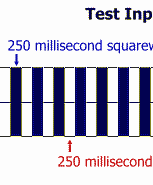
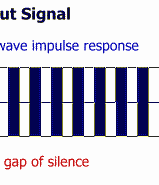
was the input test signal, which was created in Sound Forge to
be a "mono"
square wave impulse response, with a set amplitude (volume), a set
impulse length (250ms), and a set duration of silence (250ms) between
each impulse. What this gives you, is an easy to see waveform that
looks similar to bar graph (see illustration below). If the DT processes
both AMP1 and AMP2, then we should be able to easily see any changes
to our test signal.
OBSERVATIONS:
Keeping all the above background theory of timing, dynamics, and pitch
in mind, let's take a look at the DT's effect upon our test signal.
We can draw some tremendous insights about what is taking place. First,
the DT apparently uses some form of input threshold sensing, because
it appears to react to the incoming signal dependent upon how it sees
that incoming signal. Which amp models you choose, and how you play
your guitar will affect the DT differently. In other words, if you
play palm-mutes, or very staccato, or in a manner that has very distinguishable
start and stop times, the DT appears to look for those small dynamic
gaps of near silence and/or intensity between chords/notes as a trigger
mechanism. Long, fluid, non-dynamic, sustained signals, especially
when using the naturally compressed higher distortion amp models,
present fewer instances for the triggering mechanism, thereby requiring
higher parameter settings in order for the double tracking effect
to be more dramatic.
DT TIMING PARAMETER:
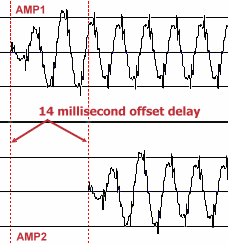
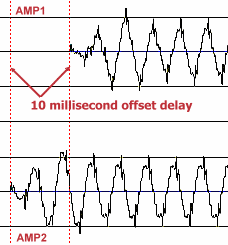
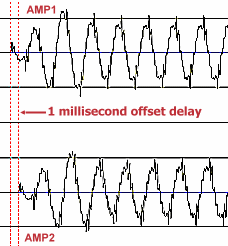
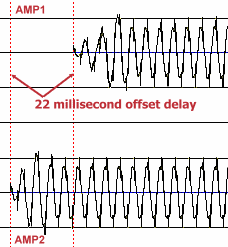
The four images below show a close up look of how the DT's Timing
Parameter affects each impulse of our incoming test signal by applying
a randomly changing offset delay to either AMP1 or AMP2. There appears
to be a wide window of offset delay times. And the Timing Parameter
adjusts just how wide this window will be. At lower settings, the
offset delays tend to be between 1ms. and 5ms. As you increase this
parameter, the offset delays can vary anywhere between 1ms. up to
22ms. and more. I did not try to discover what the maximum offset
delay might be, but as the owner's manual describes, it's enough to
make you think you're playing with a drunk guitarist.
DT DYNAMIC
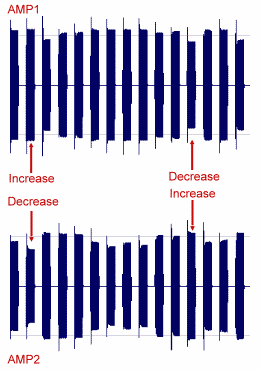
PARAMETER: The two images below show a close up look of how
the DT's Dynamic Parameter affects each impulse of our incoming test
signal by applying a dynamically fluctuating (semi-polarized?) volume
offset to both AMP1 and AMP2. In more simple terms, it appears that
as the DT applies a volume increase (or decrease) to AMP1, there is
an opposing volume change occurring in AMP2. As you increase this
parameter, the volume differences can become noticeably greater to
the point of sounding very unbalanced and unnatural.
 ..
.. 
Let me show you another
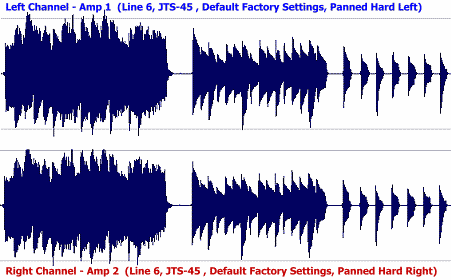
example. The first image below shows the left and right output signal
of the Vetta with the Double Tracker turned OFF. Take notice of how
the waveforms appear the same. Even though we have each amp panned
hard left and right, because the output signals are virtually-identical,
the sound is MONO, and appears at the very CENTER of the stereo field.
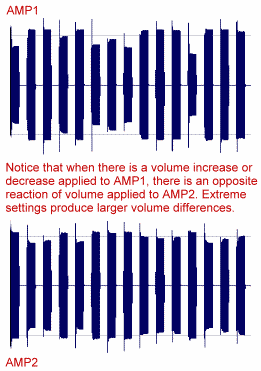
The additional image
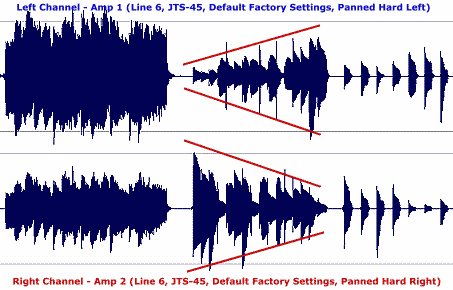
below shows how the Double Tracker's Dynamic Parameter
can affect an incoming guitar signal when turned up to extreme settings.
Once again, take notice of how the DT applies opposite volume adjustments
to both AMP1 and AMP2. As the red lines indicate, as AMP1 is processed
with a volume increase across time, AMP2 experiences a volume decease.
Extreme settings produce very unnatural and unpleasant volume shifts
between the two amp models.
PARAMETER SETTINGS:
The parameter settings for the Double Tracker can really vary depending
upon which amp(s) you decide to use. You can sonically abuse your
output signal by using more extreme settings, so try very minimum
settings when first tweaking the parameters. Using two different amp
models will help to produce more realistic results for stereo recording.
And your style of playing has a direct affect upon how the DT works.
The TIMING
parameter seems to be the most sonically useful. Just one TIMING knob
"click" past OFF is enough to make a noticeable difference,
by subtlety widening the two amps into a stereo image. At higher settings,
the timing differences increase, and produce an even more distinct
stereo image. TIMING settings up to 12 o'clock work best, and you
may find some use for settings above this, but set too high, and you
may find too much "sloppiness" between the two amps. You
may also notice that when using "identical" amp models and
settings panned hard left and right, the timing differences that occur
between AMP1 and AMP2 cause the signal to jump around in the stereo
field. But keep in mind, this is typically not the sonic result when
two different amp models are used, and it may be best to actually
use two different amp models to achieve full potential.
The PITCH
parameter simply adds a subtle detuning between the two amp models.
Minimum settings can go unnoticed. The detuning really becomes apparent
only at higher settings.
The DYNAMIC
parameter is the one most difficult to adjust. Minimum settings up
to 9 o'clock seem to work best and sound more natural. However, if
you adjust the setting too high, you will get very unnatural increases
and decreases of volume between the two amps.
FINAL CONCLUSIONS:
The Double Tracker is more easy to recognize while listening to a
playback recording of the Vetta then when you are in the midst of
playing the guitar (with the exception of using an extension cab).
When you are sitting in the "sweet" spot between studio
monitors (or between the Vetta Combo and a Vetta 212S Extension Cab),
the effect is clearly heard, and impressive enough to appreciate when
you get the parameter settings adjusted properly. Anyone with a good
ear and attention to sonic detail will definitely notice it immediately.
But realistically, how many end users are sitting in front of studio
monitors playing the Vetta direct (with the amps speakers turned off).
Some users may actually be hearing the effects of the DT, but not
recognize the effect depending upon their degree/level of experience
working with stereo signals...and so many guitar amps are mono (with
stereo fx), so many users may be less experienced with the stereo
capabilities of having two configurable amp models.
I'll be the first to say that the Double Tracker
may not be distinctly recognized if you are playing "only"
through the Vetta Combo's speakers, this is simply due to the fact
that the amps speakers are located so close to each other, and the
listener is surrounded with sound. However, the effect becomes much
more distinct when recording from the DIRECT OUTPUTS while listening
to playback on studio monitors...you are able to point to an exact
location in the stereo-field from where the sound of each amp originates,
and hear the timing, dynamic, and pitch differences.
And the DT can sound downright awesome when
using the Vetta 212S Extension Cab (or any additional extension cab)
to actually create some physical space between the amp models when
they are panned hard left and right. Having an additional Extension
Cab is the "only" and best way to compliment the Vetta Combo
so you can hear the full potential of sound that it is capable of
producing. An Extension Cab provides for a very wide "stereo"
separation of the amp models, because the Vetta Combo is handling
the LEFT side of the stereo outputs, and the Ext.Cab is handling the
RIGHT.
With the right settings,
the Double Tracker can be used most effectively with both direct recording
and live performance. The DT can produce some fantastic stereo results
provided you have the parameters adjusted to optimize the effect for
whichever amp model(s) you decide to use. Used in the home recording
studio, it can really sound very similar to a double tracked guitar.
Used on stage, it can add a "wide" 3-dimensional quality
to the sound...especially if you are using the PING PONG DELAY which
will jump between the cabs LEFT-RIGHT-LEFT-RIGHT etc.
Can it accurately re-create a double tracked guitar 100%...almost.
The technology is there and can only get better over time. Line 6
has created a winner effect in my book, and I look forward to the
day when their digital technology reaches the point of completely
fooling out sonic senses.