|
|
| |
| Line 6 Company story Line 6 started the company in 1996, Then it rapidly emerged as a music industry leader in digital modeling technology. |
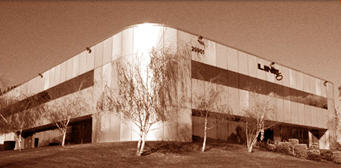
| Line 6 Company story continued As a result of it's unprecedented growth over the last several years, and to provide space for it's significant increase in R&D personnel, Line 6 had to move to a new 36.000 sq ft. building, housing design and development, administration, corporate, sales, and marketing departments. In addition to a complete interioir redeisgn, Line 6 has commisioned the services of Walter Storyk, legendary designer of Jimi Hendrix's Electrix Lady Studios, to add a custom designed state-of-the-artSound Development Studio to the new complex. Line 6 is aggressively investing in this extensive new facility to insure its continued leadership in provviding groundbreaking tone technologies for musicians. Mr. Storyk has designed the new Line 6 facillities to exactly meet the special requirements of Line 6's sound design team, providing both optimized sound analysis environments and professional quality recording spaces. The new facility completed in October 2001 and is a part of the new coporate headquarters in Augora Hills, CA that Line 6 moved to in June 2001.
In October 2001 Line 6 was again rewarded, for the second year in a row with the "Inc 500" award for being one of the top 50 fastest growing private companies in the U.S. Now the company ranked # 160 from # 168 in 2000. While bringing out new and better products for every price level in a very fast way a new direction was taken by the unveiling of the first Variax in the Autumn of 2002 Line 6 has continued to grow and at that time states that it is a music company dedicated to integrating technology with music products to develop innovative solutions for musicians. Headquartered in Augora Hills, California, Line 6 currently has a presence in over 60 countries worldwide with offices in California U.S. and the United Kingdom. In just under seven years, Line 6 has grown from an original team of 10 to 230 employees. As the pioneer of digital modeling amplifiers, Line 6 has created award-winning products for guitarists, bass players and engineers, working both on stage and in the studio. The Range of tonal possibilities that Line 6 technology providers has been put to use by an extremely diverse group of music makers, from Clint Black to Trent Reznor, from Madonna to U2, from Kid Rock to Lenny Kravtitz.
In Sept 2002 Line 6 was rankend as the telfth fastest growing technology company of the Los Angeles region, in Deloitte & Touche's "2002 Los Angeles Technology Fast 50" program. In its second consecutive year on the list, Line 6 posted a 390% revenue growth ove a five-year period. To qualify for the Fast 50, companies must be i business for a minimum of five years; must not be a subsidiary or division; must have 1997 revenues of at least $50,000, and 2001 revenues of $1 million or more; and must be considered a tecnology company which is specifically defined as a company that owns proprietary technology that contirbutes to a significant portion of the company's operating revenues.
Now in 2004 this is what their website mentions about the Line 6 company THE LINE
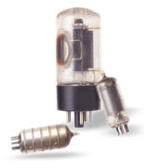
6 DIFFERENCE Most non-musicians are likely unaware that the past fifty years of guitar amplifier technology has had a more significant impact on the history of rock music than the electric guitar itself. Based on vacuum tube (or "valve") technology, each individual amp design was created to distort and color the guitar signal in a different way, contributing significantly to why the guitar sounds of the Beatles were so different from Jimi Hendrix or Pink Floyd. Both the subtle and overt differences between the many types (and even specific serial numbers) of Fenders, Marshalls, and many other brands, became cherished tonal signatures that were sought after for the particular sonic mood that they might inspire. Guitarists the world over sing the praises of that "perfect" 1958 Fender Bassman with 4 x 10" speakers, or a particular 1963 Vox AC30 Top Boost. Designs of different brands became known for their musical genre leanings, with Fender more often used for blues and country, and Marshall stacks becoming the mainstay of heavy metal and rock. A successful guitarist typically ends up owning multiple amplifiers in order to compose and record with different guitar tones. To recreate their sound live, they are often forced to bring multiple amplifiers on tour. Vacuum tube technology is still the standard for great guitar amps, yet there are very few manufacturers of these tubes left. A guitarist who wants a wide range of tone not only has to purchase multiple amplifiers, but also discovers that the most covetable amps are collectable treasures with a price tag to match. Combine this with the cost of quality replacement tubes, the variations in tone that result from the influences of different temperature and humidity, and the fact that these designs only sound "right" when played at the volume that provides the desired amount of distortion, and it becomes clear as to what challenges face the guitarist of today.
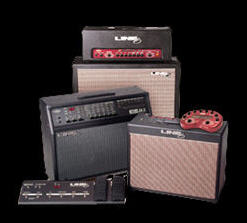
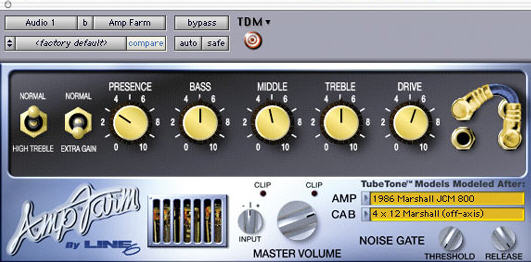
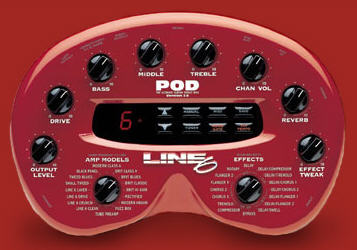
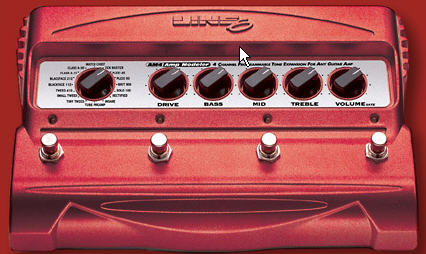
In the mid-1990's, Line 6 set out to meet the needs of today's guitarist by harnessing technology to turn a wide range of great tone into a reality for every guitarist. Line 6 amassed a noteworthy collection of sought-after vintage amps and effects, and started meticulously measuring and analyzing every tonal aspect of the tubes and their associated circuitry. Since an electric guitar produces an electrical signal, each element of the circuitry that alters the tone of the guitar is in fact processing that signal. By creating software models in DSP (Digital Signal Processing) of how the guitar signal is processed by these circuits, Line 6 had the ability to connect up and control these virtual circuits in any way. If a different type of tube was needed or tone controls should work in a different way, new software was loaded instead of having to wire additional circuits and tubes. After years of research and playing, Line 6 launched a patented technology in 1996, with the world's first digital modeling guitar amplifier, the AxSys 212. This product provided users with models of dozens of classic guitar amplifiers, as well as a complete arsenal of stomp boxes and effects. With one touch of a button, a guitarist's complete rig could be transformed into virtually any gear desired. The AxSys quickly took off and led to the further development of Line 6's technology into a comprehensive line of guitar amps within all price ranges. At the end of 1998, Line 6 launched the next guitarist tone revolution: POD. This kidney bean-shaped desktop device went beyond just the modeling of many classic amplifiers, it was created to solve another critical problem that had plagued guitar players: recording great guitar tone. With traditional amplifiers, the first problem is the requirement of a great sounding and acoustically isolated sound room, since most guitar amplifiers have to be turned up to a near ear-splitting level in order to get the right tone. Next, great microphones need to be selected and placed in optimal locations. For all but those with large recording budgets, this has been a continual struggle. And even with a large budget, it can be quite time consuming since to arrive at the desired result this process may need to be repeated with several different amplifiers.
With POD, Line 6 eliminated the need for complicated recording set-ups with its proprietary technique for simulating the complex interaction of microphones, speaker cabinets and room acoustics, Acoustically Integrated Recording (A.I.R.). POD provides software models of 32 classic and modern guitar amplifiers, plus models of their speaker cabinets, and modeling of what these would sound like when placed in a great recording studio with top quality mics placed by an experienced engineer. POD can simply be plugged directly into a recording device (tape recorder, hard disk recorder, or computer), and provide the guitarist with the complete recording signal path without ever having to move air or wake the neighbors. POD has won numerous awards, and has landed on countless platinum records. Its intuitive design and incredible tone quickly changed the way guitarists create and record music, becoming the standard for both direct recording and live performance. In 2000, Line 6 continued its expansion with a line of "stomp box" effects pedals for guitarists; Bass POD, providing all of the technological advances of POD to bass players; POD Pro, a rack-mount version of POD for live and professional studio applications; and Flextone II, a complete line of digital amplifiers. True to its commitment of putting the latest technology into the hands of musicians, Line 6 has equipped many of its new product introductions with ToneTransfer, creating a complete product line of internet-enabled digital audio products. Now, Line 6 users can utilize the sounds created in a studio environment and reproduce them on stage, share sounds with other users, and access over a thousand new sounds via Line 6's ToneTransfer Web Library. 2001 marked the introduction of a new generation of modeling technology with Vetta, Line 6's flagship amplifier. It brought innovative features, including the ability for players to attain the sound of two different amplifiers at once. Line 6 also introduced products for the music production market with Line 6 Studio Modelers, which are receiving critical acclaim and editor's recognition in top music publications. Most recently, in March 2002, Line 6 introduced GuitarPort, the first computer-based musical experience for electric guitarists. This device transforms an ordinary PC into an arsenal of incredible sounding guitar amps and effects, plus gives you the ability to play along with great studio musicians as well as original master recordings of some of the most famous guitar tracks of all time. An ever-growing list of popular songs recorded with and without guitar are also available, as well as on-line lessons and guitar forums. Line 6 "Jamware" puts any guitarist into the middle of the band any time of day, anywhere there is a PC. Line 6's passion for excellence and commitment to the development of new technologies has attracted the industry's best engineers and designers, a formidable roster of artist endorsers, and an active, informed user base - a combination that leaves Line 6 well-equipped to take on the enviable challenges of continued growth. |
*Line 6®, Line 6 Inc., AX2, AxSys, BackTrack, BackTrack+Mic, Bass Floor POD®, Bass POD®, Bass POD® xt, Bass POD® xt Pro, Bass POD® xt Live, Constrictor™, Crunchtone™, Customtone, Duoverb, DL4™, DM4™, Echo Park™, Eight Ball, Filter Pro™, Flextone™, Floorboard, Floor POD®, Floor POD® Plus, FBV Express™, GearBox™, GearBox™ Plug-In, Guitarport™, GuitarPort® RiffTracker™, GuitarPort® xt, FM4™, HD147®, Jamware, JM4 Looper, LowDown, Liqua Flange™, M13, MM4™, MOD Pro, POD®, Pocket POD®, Pocket POD® Express, POD® FARM, POD® Studio, POD® xt, POD®xt Pro, POD® xt Live, POD® X3, POD® X3 Pro, POD® X3 Live, Rifftracker™, Roto Machine™, Space Chorus™, Spider™, Spider-Jam™, Spider-Valve™, ToneCore™, TonePort™, TubeTone, Ubermetal™, GX, UX1, UX2, UX8, Verbzilla™, Vetta™, Variax®, Variax® Acoustic, Variax® Workbench™ and Line 6 logos are trademarks of Line 6, Inc. RiffWorks, InstantDrummer™, Riffcaster, Rifflink and Sonoma Wire Works™ are trademarks of Sonoma Wire Works™. Atomic, Atomic Amps, LLC, Atomic Reactor 112, Atomic Reactor 112-50 and Atomic Reactor 212 are trademarks of Atomic Amps. Bose® and Bose® Personalized Amplification System™ are registered trademarks of Bose. T1 Tonematch, L1, All rights reserved. Vinny appears exclusively
for Vettaville.nl with courtesy of Vettaville Records Inc. All other product names used on this website are trademarks of their respective owners, which are in no way associated or affiliated with Vettaville.nl or Vettaville.net. These trademarks of other manufacturers are used solely to identify the products of those manufacturers to identify a certain tone or sound. Entire contents Copyright
© 2003-2008 Vettaville.nl. All Rights Reserved. Copyright © Vettaville.nl 2003-2008, All rights reserved. |